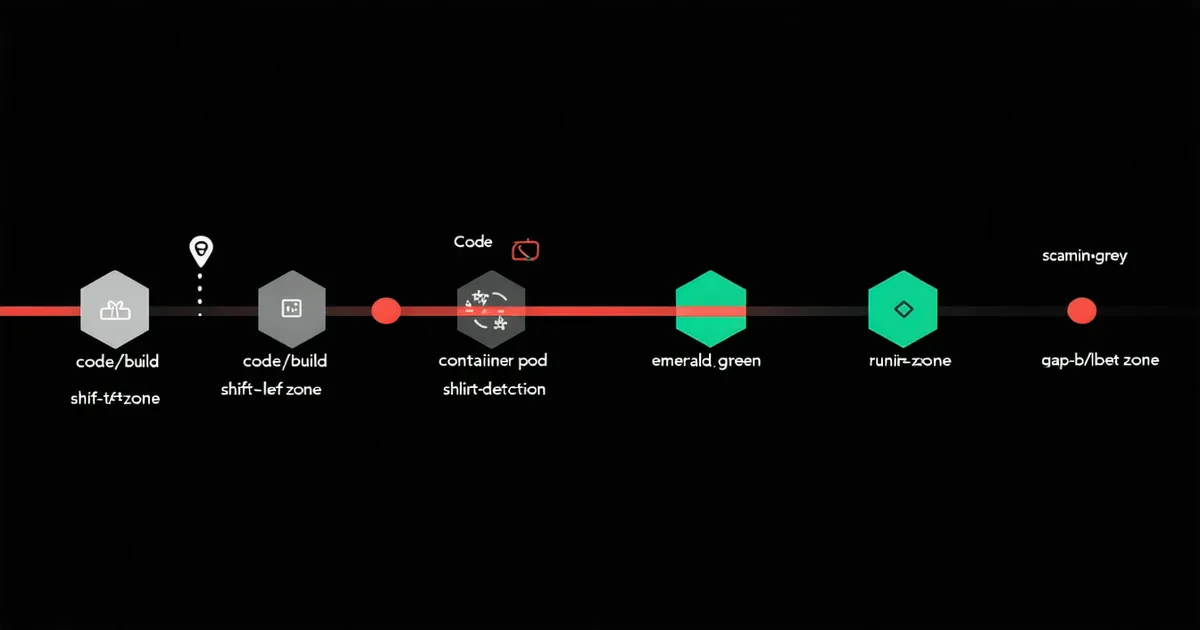
Where Shift-Left Ends
The shift-left security movement answered a real problem: vulnerabilities found late in the development cycle are expensive to fix and often get deployed before remediation is complete. Running Trivy in CI to block CVE-containing images, integrating Semgrep into the developer's editor, enforcing OPA policies at admission time — these are genuinely valuable controls that have measurably reduced the number of known-vulnerable dependencies reaching production.
But "left" has a boundary. It is the moment the container process starts executing. At that point, the security controls that operated on static artifacts (image manifests, Dockerfiles, Kubernetes YAML files) have done everything they can do. What happens next — which system calls the process makes, which network connections it opens, whether it attempts to read credential files, whether it tries to escape its namespace — happens at runtime, in the kernel, and is invisible to every shift-left tool in your pipeline.
This isn't a theoretical gap. An attacker who exploits a zero-day in a web framework running in a pod — a vulnerability with no CVE because it was discovered and exploited before disclosure — bypasses your image scanner cleanly because there's nothing to scan for. The exploit code doesn't exist in the image; it arrives in an HTTP request after the container is running. The attacker achieves code execution, pivots to the K8s API using the pod's ServiceAccount token, creates new workloads with escalated privileges, and begins lateral movement. Your image scanner's last report showed "no critical CVEs." It was accurate, and it was useless.
The Specific Threat Classes That Only Runtime Covers
It's useful to be concrete about which threat classes are detectable only at runtime, because this shapes how you think about defense coverage:
Zero-day post-deploy exploitation: By definition, no signature exists for a zero-day. Image scanning works by matching packages against known vulnerability databases. The behavioral pattern of exploitation — unusual process spawning, unexpected syscall sequences, namespace operations that the container image's normal operation doesn't include — is detectable at runtime via deviation from the known-good baseline. The signature-free detection approach catches novel exploits that pattern-matching cannot.
Legitimate-but-compromised images: Supply chain attacks that inject malicious code into otherwise-legitimate packages (the XZ Utils backdoor disclosed in 2024, npm dependency confusion attacks, PyPI typosquatting campaigns documented throughout 2023-2025) produce images that pass CVE scanning because the malicious code doesn't match any CVE signature. Once the container starts and the dormant payload activates, the behavioral pattern is observable at the kernel level.
Configuration misuse after deploy: A container image may be scanned clean and admitted with appropriate PodSecurityStandards, but if an attacker gains code execution via application-layer vulnerability, they can then misuse the configuration that was legitimately permitted. A pod that legitimately has NET_ADMIN capability for network configuration can have that capability abused post-compromise to redirect traffic. The configuration was correct at admission time; the exploitation is a runtime event.
Credential theft from mounted secrets: Kubernetes mounts ServiceAccount tokens at /run/secrets/kubernetes.io/serviceaccount/token in every pod by default (unless you explicitly disable it with automountServiceAccountToken: false). An attacker with execution in a pod can read that token and use it to call the K8s API. This is a file read event — detectable at runtime via the open() syscall on that path — not a container configuration problem.
The Argument Against Runtime-Only Postures
We're not saying shift-left security is insufficient and runtime detection alone is enough. We're saying the opposite: runtime detection alone is also insufficient, and neither layer substitutes for the other.
A team that skips image scanning in favor of runtime detection is making a poor tradeoff. Known-vulnerable packages are preventable at build time with effectively zero operational overhead. Running a container with an exploitable CVE and hoping your runtime detector catches the exploitation is strictly worse than not running the vulnerability in the first place. The shift-left controls that block known-bad configurations before they reach production are valuable precisely because they eliminate a large class of risk cheaply.
The layered model: shift-left controls reduce the attack surface that reaches production. Runtime detection covers the residual attack surface that shift-left can't reach. Both layers are necessary; neither is sufficient. The failure mode that prompted Kubesentry's founding was a production environment that had invested heavily in shift-left (image scanning passed, admission policies were enforced, no known CVEs in the deployed images) but had no runtime visibility — so when an attacker exploited a misconfigured deployment post-deploy, the absence of runtime monitoring meant the cryptomining ran undetected for nearly two weeks before a billing anomaly surfaced it.
How the Threat Surface Changes After Container Start
The runtime threat surface includes elements that simply don't exist before execution:
Dynamic code execution: Scripted languages (Python, Node.js, Ruby) can download and execute code at runtime via network requests. The image that was scanned contained only the application code present at build time. Code executed from a remote URL after startup was not present in the image and is not scannable.
Sidecar interaction: In service mesh architectures (Istio, Linkerd), sidecar proxies intercept all network traffic. A compromised sidecar has visibility into all traffic in and out of the pod. Sidecar injection happens at runtime via MutatingAdmissionWebhook — the application image has no knowledge of the sidecar at build time.
Live credential rotation: ServiceAccount tokens are rotated by the token controller. The token value in the image at build time is not the token value at runtime. The live token in the filesystem at runtime is the actual credential with K8s API access.
Environment variable injection: Secrets mounted as environment variables from Kubernetes Secrets are injected at pod creation, not at image build time. The image scan sees none of this. A misconfigured Secret that exposes database credentials to a compromised pod is a runtime exposure, not a build-time one.
Building a Coherent Security Timeline
A practical way to think about the coverage split: draw a timeline from code commit to production. At each stage, ask which controls operate and what threat classes they cover.
Pre-commit (developer IDE, pre-commit hooks): SAST catches SQL injection patterns, hardcoded secrets, dangerous function calls. CI pipeline: image scanning catches known-CVE packages, dependency auditing catches vulnerable transitive dependencies, Dockerfile linting catches misconfigurations. Admission: PodSecurityStandards blocks privileged containers, OPA/Kyverno enforces organizational policies, NetworkPolicy defines allowed traffic paths. Runtime: eBPF-based syscall monitoring catches exploitation behavior, namespace operations, process anomalies, network anomalies, credential access.
The key insight is that each stage has a hard right boundary. Shift-left controls don't extend past the admission boundary; runtime controls don't operate before the container starts. A coverage map that treats them as competing rather than complementary is misidentifying the problem.
The question for most engineering teams isn't "shift-left or runtime" — it's "do we have runtime coverage to complement our shift-left investment?" For teams who have image scanning, OPA policies, and PodSecurityStandards in place but no runtime detection, the residual risk is real and measurable: zero-day exploitation, supply chain compromise activation, and post-deploy credential theft are all threat classes in the uncovered window.
The three-layer K8s security model covers the full build/deploy/runtime stack in detail. For the runtime detection layer specifically, the Kubesentry platform and its container escape detection coverage demonstrate what kernel-level visibility adds to the threat classes shift-left tools can't see.